
Slot players cannot answer the question of how much they should bet per spin. Players make up their bet size in their heads on the fly. One player will choose a 50p bet size because that is the reel default; another will bet £2 because “it feels right” after winning a couple of rounds. Rarely will players arrive at their bet size due to any rational thinking and thus, many sessions end too early and in a sour state.
Bankroll Management in Slot Play Comes From Poker and Sports Betting — Because That’s Where the Math Cares About the Game Played
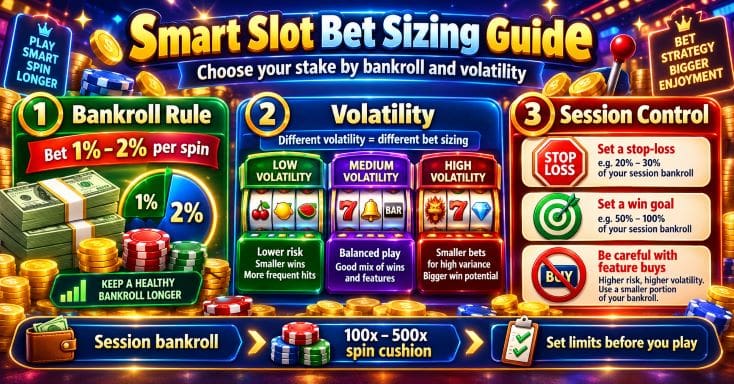
People talk about the 1% rule (sometimes referred to as the 2% rule) as a basis for starting bankroll management in slots. The concept is simple. Take your overall bankroll (the money you’ve allocated for gaming and can afford to lose), and bet between 1% and 2% of that per spin. For example, if you have a $50 bankroll for the week, a 1% stake would be a 50-cent-per-spin bet and a 2% stake would be a dollar per spin. Scaling this up, a $500 bankroll could support $5 to $10 spins per spin. This is not a fixed law engraved into the pay table, but a model that allows you to remain in the game long enough to allow you to experience the natural swings that a slot is designed to generate, versus handing over your entire bankroll for three consecutive uneventful spins.
The primary advantage of using percentages rather than dollar amounts for bet sizing is that it disconnects your overall bankroll from your session bankroll and your session bankroll from your unit bet size. Your overall bankroll represents the large picture number of dollars you’re allocating to slots for a month or for a trip. Your session bankroll represents a segment of that, the money you’re taking to the table for play on any particular day. And finally, your unit bet size is a very small portion of your session bankroll. Too many players are working in reverse order. A common rule that complements percentage-based betting is to ensure that you have enough overall bankroll to endure anywhere between 100 to 500 times your average bet. If you bet $1 per spin, that equates to having a session bankroll ranging from $100 to $500, depending upon how cautious you wish to be. Games with low volatility tend to work best with the smaller side of that range while games with high volatility (games with extended periods of quiet followed by large payouts) prefer you to be close to the larger end of that range to provide adequate cushion against those dry-spell areas.
Determining Bet Sizes Based Upon Low-Volatility, Medium-Volatility, and High-Volatility Slots
Variance, or volatility, is the greatest determinant of how you should adjust your bet size. Although most players do not consider this aspect, two slots can have the exact same RTP (return-to-player ratio) yet seem dramatically different to play. That is primarily due to one slot being volatile and the other stable. A volatile slot provides occasional large wins, but there may be extensive periods between such wins. Conversely, a stable slot delivers frequent moderate wins. A $50 bankroll can last a long time playing a stable slot even with a higher bet size because the potential losses will rarely include extended losing runs.
There are many slots that exist in the middle ground between volatile and stable slots. They deliver infrequent larger wins combined with relatively stable base-game win rates. Most modern video slots fall within this category. Therefore, the 1-2% guideline for determining bet sizes can be applied nearly identically to medium-volatility slots.
For slots that are extremely volatile (often referred to as Megaways or progressive-jackpot-type slots), extreme caution is required. These slots can spend dozens or even hundreds of spins without delivering a significant win, and then provide ten, fifty or several hundred times the bet size in one large win. To maximize longevity while playing high-variance slots, reduce your bet size rather than increasing it. A player with a $100 bankroll who plays at $2 per spin on a Megaways-type high variance slot is often broke before he ever reaches his first feature. By reducing the same bankroll to 50-cent spins, he maximizes the number of spins he can survive until the feature occurs.
Determining How Long a Session Should Be
Spin counts are generally more relevant than hours spent playing when considering how long a session should last. The reason for this is twofold. First, when players select a bet size, they are selecting how many spins per hour they will incur, and that directly impacts how quickly their spin count burns off. Second, as mentioned previously, varying levels of volatility impact how many spins occur prior to receiving a payout. When evaluating session length using hours, neither of these factors are taken into consideration.
To more effectively determine expected session length, evaluate the total number of spins your session bankroll can survive based upon your selected bet size. A basic method to calculate this is by dividing your session bankroll by your selected bet size. The result will represent your maximum possible spin count in case of no winnings (which never happens). A $50 session bankroll at 50 cents per spin affords 100 spins of runway; at $1 per spin, only 50 spins are available. The numbers themselves do not reveal what will happen during your session; however, they tell you what constitutes an acceptable session length prior to beginning and help prevent you from pursuing losses beyond what is warranted.
Extending session duration is simply choosing smaller units of currency for each spin (i.e., lowering your bet size).
Player selection of an increased bet size after experiencing a loss is a classic pattern observed among novice players. Increasing your bet size increases your risk exposure and reduces the number of spins remaining in your session. This behavior exacerbates what otherwise might be a manageable dry-spell into an entire lost bankroll.
Players incorrectly assume that placing bets at max value will increase their chances of winning due to either enhanced odds or additional bonus features. This misconception persists because some slots activate additional features or award greater jackpot values when placed at max value. However, most slots have their RTP incorporated into the game regardless of the initial bet size; therefore, verify whether the additional features or enhanced odds apply prior to increasing your bet size.
Some players fail to understand that adjusting the number of lines played, ways to win and/or adjusting coin value multipliers are independent of the displayed total stake per spin. Ignorance regarding how these various adjustments affect your bet size can lead to significantly exceeding (and/or falling short) your intended bet-size per spin.
As referenced above, novice players frequently establish an overall bankroll for the trip but fail to break down that amount into session-sized allocations. Consequently, one poor afternoon of play depletes an entire week’s worth of funds earmarked for continued gaming.
Feature Buy Options Impact Bank Roll Size
Bonus buy and feature buy options require distinct funding allocations from your bank roll. Bonus buy options require purchasing access to a bonus round or feature at a flat multiple (commonly 50x – 150x) of your typical per spin bet. Purchasing a bonus round or feature at 100x your typical per spin bet in a slot where you typically play at $1 per spin costs you $100 per purchase opportunity. As such, utilizing feature buy options can rapidly exhaust your session bank roll.
If you plan on using feature buy options, begin by establishing how many feature buys you can afford at your desired cost per option rather than initiating play with enthusiasm. Consider feature buy opportunities as unique funding allocations apart from your standard per-spin budget. Additionally, remember that wagering requirements associated with promotional bonuses and free spins may prohibit or vary bonus-buy contributions relative to base-game spins.
Progressive Jackpots Have Unique Requirements
Like feature buy options, progressive jackpots require special attention to avoid overspending on bets per spin. Many progressive jackpots require a maximum-bet per spin or minimum-bet per spin to be eligible for the largest possible progressive jackpot prizes. Therefore, if you intend on participating in progressive jackpots with potentially large prizes, consider using smaller unit bets for maximum profitability.
Quantifying the Amount Spent Per Spin
While theoretical models are useful guidelines for determining bank roll allocations for various bet-sizes, ultimately none of them function as pure theory alone. Here are examples demonstrating how the math works out for a few different bank rolls. For instance, someone playing at $1 – $2 per spin on a mid-volatility slot using 1-2% bank-roll management would likely have a $50 overall bank roll supporting 50-cent-$1 per-spin bets; or alternatively a $200 overall bank roll supporting $2-$4 per-spin bets on the same mid-volatility slot; or finally an overall bank roll of $1,000 supporting $10-$20 per-spin bets on the same mid-volatility slot (though numerous experienced players will intentionally scale-down their overall bank roll percentiles [e.g., 0.5%] as they grow more confident in their ability to manage their overall spending).
Knowing When to Exit
An important phrase to reflect upon when discussing expected losses for a slot-session is that it fundamentally changes how we think about what a slot-session is. Each and every spin includes a predetermined house-edge inherent in its RTP; hence, after sufficient spins (regardless of how well you have managed your bets) the mathematical expectation is that you will lose a small proportion of all monies wagered.
Good bankroll management does not eliminate expected-losses from occurring; however, it helps regulate how those losses manifest and preserves the possibility of obtaining actual-good outcomes by preventing those adverse outcomes from eliminating your session prematurely; thus preserving good-outcome opportunities throughout the course of your session.